

Terpenes, Phenylpropanoids, and All the Rest: A Guide to the Chemistry of Essential Oils
When you read an essential oil label, you see a single name: lavender, eucalyptus, cinnamon. But chemically, what's in the bottle is never a single compound—it's a mixture of 20 to even over 300 different molecules, built by the plant from just a few common "building blocks." This post shows how this small set of building blocks creates an entire library of scents and why it matters when choosing an essential oil—not just when smelling it.
We rely on the scientific review Essential Oils: Chemistry and Pharmacological Activities (Lima et al., 2023, Biomolecules journal, MDPI), which compiled data from experimental studies in PubMed/MEDLINE on the chemical structure and mechanisms of action of essential oils. We will also show original diagrams from this work—they are available under a CC BY license, so we can cite them here with proper attribution.
An essential oil is not an oil. So what is it?
The first thing to clarify: fatty oil (e.g., almond oil) and essential oil (e.g., lavender essential oil) are chemically entirely different worlds. Fatty oil is a triacylglycerol—an ester of glycerol and three fatty acids. An essential oil is a completely different family: a complex, volatile, and lipophilic mixture of small plant compounds, obtained mainly by steam distillation (and from citrus fruits—by pressing from the pericarp).
Typical essential oil molecules have a mass below 300—that's why essential oils evaporate so easily and smell so intensely. A single bottle can contain 20-60 components, and some essential oils have over 300. Usually, two or three dominate quantitatively, but—and this is important—these minor components are by no means "background noise." They can enhance, weaken, or modify the action of the main compounds.
Where does this diversity come from? The plant doesn't invent every molecule from scratch
This is where this scientific review does something truly good educationally: it shows that a plant doesn't build hundreds of scents from scratch. It starts with a handful of common precursors, and then through cyclizations, rearrangements, and oxidations, it creates a vast library of shapes from them.
Chemically, essential oil components fall into two major families:
- Terpenoids — built from isoprene units, giving most "green," citrus, resinous, herbal scents
- Phenylpropanoids — built around an aromatic ring, giving "spicy" and "condimentary" scents — clove, cinnamon, anise
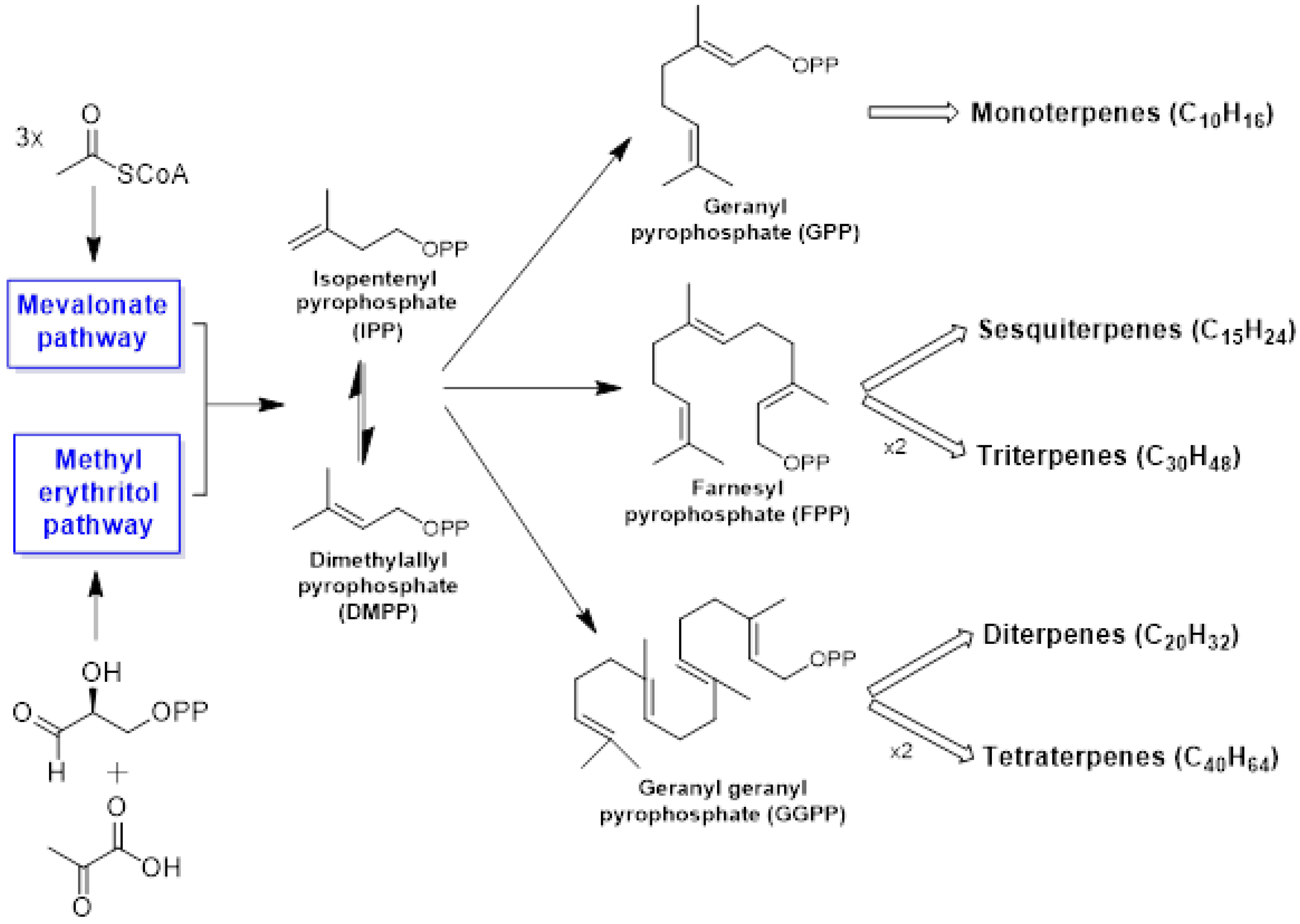
Fig. 1: Two biosynthesis pathways (mevalonate and MEP) lead to common precursors GPP, FPP, and GGPP, from which mono-, sesqui-, and diterpenes are formed, respectively. Source: Lima et al., 2023, Biomolecules 13(7):1144, MDPI, CC BY license.
Imagine GPP or FPP as flexible, linear "carbon ribbons" with a diphosphate handle at the end. The terpene synthase enzyme cleaves this handle and initiates a cascade: the molecule folds, closes into rings, undergoes rearrangements—and ends up as one of many possible skeletons.
Monoterpenes: the lightest and most recognizable family
From the GPP precursor (10 carbon atoms), monoterpenes are formed—the most volatile and common components of essential oils. The diagram below shows how entire types of skeletons "branch out" from a single starting point: acyclic (linalool, citronellol), bornane (camphor, borneol), pinane (α-pinene, β-pinene), or p-menthane (limonene, menthol).
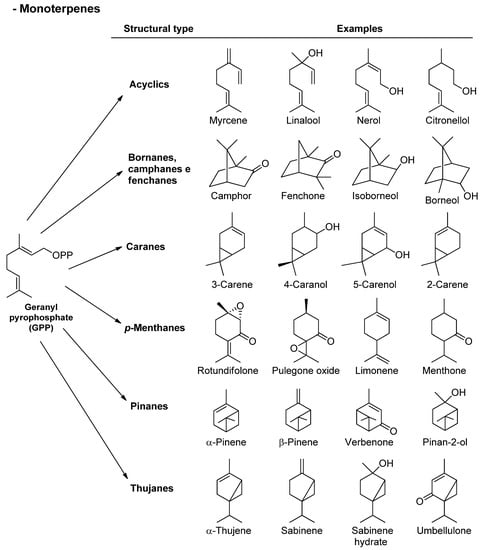
Fig. 2: Monoterpene skeleton families derived from GPP. Source: Lima et al., 2023, Biomolecules 13(7):1144, MDPI, CC BY license.
A good example of how a minor chemical change alters the entire compound: in caraway fruits, the pathway leads from GPP through (+)-limonene and (+)-trans-carveol to (+)-carvone—a three-step, well-described biosynthesis in which the addition of one oxygen atom converts the hydrocarbon first into an alcohol and then into a ketone.
Sesquiterpenes: more carbon, more possible shapes
From the FPP precursor (15 carbon atoms), sesquiterpenes are formed. The elongation of the chain and a greater number of possible cyclizations immediately increase diversity: from linear structures to mono-, bi-, and polycyclic ones.
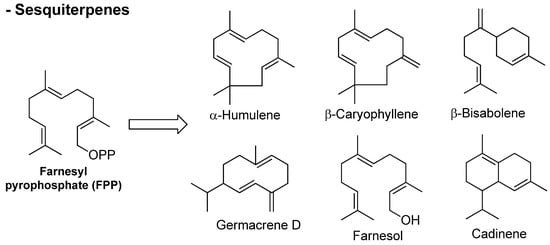
Fig. 3: Diversity of sesquiterpene skeletons from C15 material. Source: Lima et al., 2023, Biomolecules 13(7):1144, MDPI, CC BY license.
One of the best-known examples of a sesquiterpene formed only during distillation is chamazulene—the blue compound responsible for the characteristic color and soothing action of yarrow essential oil. It is not present in the plant in this form—it is formed from a precursor (matricin) only under the influence of heat and steam during distillation.

Rich in chamazulene—a sesquiterpene that soothes reactive and sensitive skin. Each batch with GC/MS testing.
View product →
The second major family: phenylpropanoids
Phenylpropanoids have a completely different biosynthetic origin—they come from the shikimate pathway, and their precursor is the amino acid L-phenylalanine. Instead of alicyclic rings, we have aromatic skeletons with various substituents here.
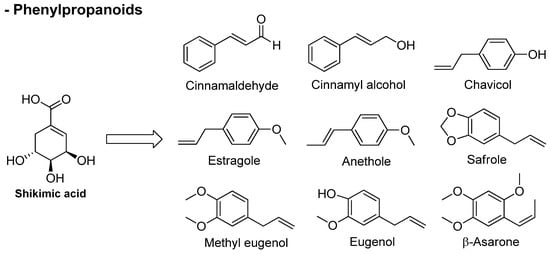
Fig. 4: Typical phenylpropanoids present in essential oils, from shikimic acid to eugenol and anethole. Source: Lima et al., 2023, Biomolecules 13(7):1144, MDPI, CC BY license.
One of the most recognizable phenylpropanoids is trans-anethole—the compound responsible for the warm, sweet licorice scent of both anise and sweet fennel. This is a good example of how two botanically different plants, from different families, can share the same dominant chemical compound—and thus a very similar scent profile and application.
 Anise Essential Oil (Pimpinella anisum), natural
Dominant compound: trans-anethole. Supports digestive comfort, warm and licorice scent.
View product →
 Fennel Essential Oil, sweet fennel (Foeniculum vulgare var. dulce), certified organic
The same dominant compound—trans-anethole—in a different plant. A milder, sweeter profile.
View product →
One thing to note here: eugenol (clove scent) and isoeugenol are not a simple "bond flip." In the plant, both originate from a common, earlier stage of the phenylpropanoid pathway—and only in technical chemistry can isoeugenol be obtained from eugenol by isomerization in the laboratory. This is different from natural biosynthesis.
When the "handedness" of a molecule matters
Yet another level of complexity: even with an identical chemical formula, the scent can change simply because the molecule is "left-" or "right-handed" (enantiomer). A classic example is carvone: the (R)-carvone enantiomer gives the characteristic spearmint scent, while (S)-carvone is responsible for the caraway aroma. The same compound name, two completely different scents—depending on which "hand" the particular plant holds.
What this chemistry does in the body
The review authors show that different chemical families have different mechanistic "points of attachment" in biology—it's not one generalized action of "essential oil is healthy."
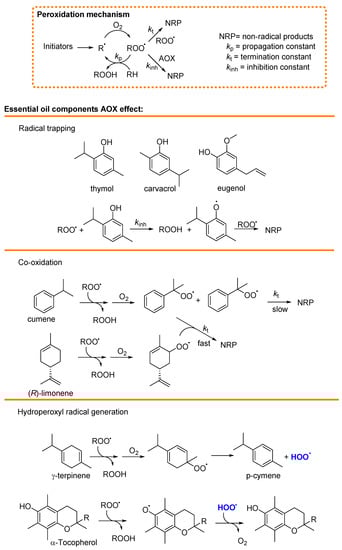
Scheme 1: Three different antioxidant mechanisms—phenolic compounds as radical scavengers, termination by oxidizable components, and gamma-terpinene transformation. Source: Lima et al., 2023, Biomolecules 13(7):1144, MDPI, CC BY license.
Phenolic components such as thymol, carvacrol, and eugenol act as radical scavengers—they donate a hydrogen atom to a peroxyl radical and form a stabilized phenoxyl radical. Another mechanism shows γ-terpinene, which upon oxidation yields p-cymene and a hydroperoxyl radical. These are two completely different ways of "being an antioxidant" within one chemical family.
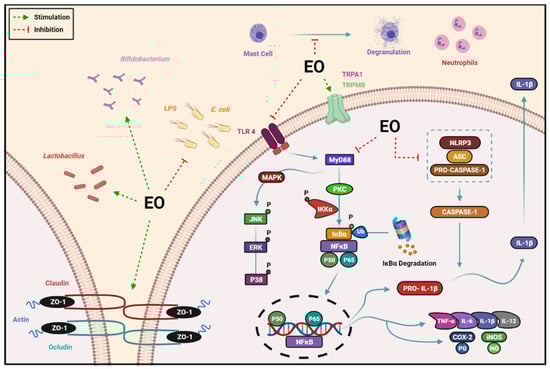
Fig. 6: Network of possible anti-inflammatory mechanisms—from classical signaling pathways to sensory receptors and microbiota. Source: Lima et al., 2023, Biomolecules 13(7):1144, MDPI, CC BY license.
Similarly, in the anti-inflammatory section: carvacrol acts via the TRPA1 receptor, eucalyptol via TRPM8, pulegone inhibits the NLRP3 inflammasome, and essential oils rich in linalool suppress the MAPK/NF-κB axis. "Essential oil has anti-inflammatory effects" is in practice a shorthand for an entire network of possible interactions, not a single phenomenon.
Summary: two families, two worlds of scents
| Feature | Terpenoids | Phenylpropanoids |
|---|---|---|
| Biosynthesis precursor | IPP/DMAPP → GPP, FPP, GGPP | Shikimic acid → L-phenylalanine |
| Typical scent profile | citrus, resinous, herbal, woody | spicy, condiment, sweet-balsamic |
| Example compounds | limonene, linalool, chamazulene, caryophyllene | eugenol, anethole, cinnamaldehyde |
| Example essential oils | yarrow, citrus, eucalyptus | anise, fennel, cinnamon, clove |
Where enthusiasm ends and caution begins
This review is a very strong map of mechanisms, but not proof that every essential oil used by humans yields a predictable clinical effect on the same scale as in molecular, cellular, or animal studies on which it is based. This is an important distinction: "a promising candidate for further research" is not the same as "a ready, standardized product with proven clinical efficacy."
The second caution concerns the very notion of "this essential oil." Composition and quality depend on the stereochemistry of components, extraction method, climate, soil, plant age, vegetation phase, and harvest time. Chemically, there is no abstract "essential oil from plant X"—there are specific, measurable composition profiles. That's why GC/MS testing of each batch, not just the botanical name on the label, truly tells you what's in the bottle.
Most Frequently Asked Questions
How does an essential oil differ from a fatty oil, like almond oil?
Chemically, they are completely different substances. Fatty oil is a triacylglycerol (an ester of glycerol and fatty acids)—non-volatile and greasy to the touch. An essential oil is a volatile mixture of small, lipophilic plant compounds, obtained by distillation. That's why fatty oils, like almond oil, are excellent as carrier oils for diluting essential oils before skin application.
Why can two essential oils with the same botanical name differ?
Because the chemical composition depends on many variables: climate, soil, plant age, harvest phase, and extraction method. The species name alone does not guarantee an identical component profile—that's why specific testing of a given batch, not just the label, matters.
What exactly does GC/MS testing show?
Gas chromatography coupled with mass spectrometry separates the essential oil mixture into individual components and identifies each one. This is the only way to genuinely check if what is declared on the label is in the bottle—and in what proportions.
Does this mean essential oils act like medicines?
Not in the sense of a standardized, clinically tested drug. The studies cited in this review are primarily molecular, cellular, and animal models—they show mechanisms and potential, not ready clinical applications in humans.
Want to check what's really in your essential oil? Every AromaPremium batch has a number and GC/MS test result visible on the product page—because in aromatherapy, composition, not name, makes the difference.