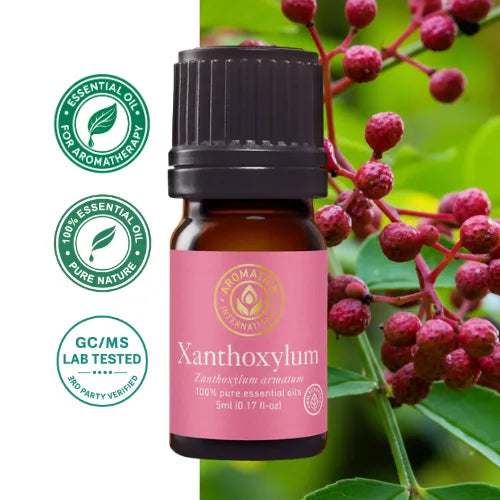


Zanthoxylum armatum (Sichuan pepper) fruit essential oil – properties
Share
The main ingredients of the oil
Sichuan peppercorn oil, obtained by distillation, is characterized by a high content of monoterpenes. The dominant compound is linalool (constituting approximately 58–72% of the composition), along with limonene, sabinene, linalyl acetate, and methyl cinnamate[1][2]. The fruit also contains unique alkylamides called sanshols (e.g., hydroxy-α-sansol), responsible for the specific sensory effect of Sichuan peppercorns[3]. These components give the oil an intense aroma and a characteristic peppery-citrus flavor with a tongue-numbing effect.
Due to the rich chemical composition of the essential oil from Zanthoxylum armatum fruits, including a high content of biologically active volatile compounds (including linalool and monoterpenes), the authors point to its potential usefulness in the context of aromatherapy and so-called forest medicine , emphasizing, however, that this direction requires further, targeted experimental research.
Antimicrobial properties
Studies have shown that Z. armatum essential oil has potent antimicrobial properties. In vitro, it inhibits the growth of various bacteria and fungi, demonstrating antiseptic, antibacterial, and antifungal effects.[4] Furthermore, antiparasitic activity has also been demonstrated – the oil has been shown to be active against parasitic worms (antihelminthic properties).[4] These properties explain the traditional use of Sichuan pepper for disinfecting wounds and skin infections. Dried fruits are used as an essential oil and also have antiseptic, antifungal, and antibacterial preparations.[5]
Antiparasitic effect
Z. armatum is known in traditional medicine as a plant that helps fight parasites. Sichuan peppercorns are effective in combating internal parasites – administering powdered fruit has been shown to help eliminate intestinal roundworms (e.g., roundworms) from the gastrointestinal tract .
In one study, fruit extract expelled roundworms (ascarids) from children thanks to its antiparasitic properties Z. armatum preparations are also used externally for parasitic skin infections – traditionally, a lotion made from the fruit was used to treat scabies (a parasitic skin disease) due to its antiseptic and disinfectant properties. The essential oil itself has antiseptic, disinfectant, and deodorizing properties, which help fight skin infections caused by microorganisms and parasites. .
Anti-inflammatory and antioxidant properties
A significant feature of Z. armatum fruit oil is its antioxidant and anti-inflammatory properties. In laboratory studies, oil extracts demonstrated strong antioxidant activity in various chemical assays (including the ability to reduce iron ions and scavenge free NO radicals)[2]. Concurrently, anti-inflammatory effects were observed – the oil inhibited, for example, protein denaturation and excessive nitric oxide (NO) production in immune cells stimulated by an inflammatory factor[2]. At the molecular level, the anti-inflammatory effect is largely due to the oil's components, such as linalool and linalyl acetate, which limit the production of pro-inflammatory cytokines (including TNF-α and IL-6) by cells**[10]. This allows the oil to alleviate inflammation and oxidative stress, a finding confirmed in in vitro models.
Anti-asthmatic effect (respiratory system)
Traditionally, Sichuan pepper has been used for respiratory ailments, a finding confirmed by studies on asthma models. In vivo animal experiments have shown that Z. armatum oil has a bronchodilator effect and may alleviate asthma symptoms. In guinea pigs, inhalation of the oil significantly prolonged the time to the onset of dyspnea and bronchoconstriction following histamine challenge[11]. In turn, in mice modeling allergic asthma, administration of the oil reduced inflammatory infiltrates in the lungs, lowering the number of eosinophils and neutrophils in the bronchoalveolar fluid, as well as IgE levels in the blood[11]. Histopathological studies confirmed that the typical asthmatic changes in animals treated with the oil reversed[12]. These results provide evidence that Z. armatum oil has bronchoreanic and antiasthmatic properties, which explains its traditional effectiveness in folk therapies for asthma.[12] This oil may therefore find supportive use in respiratory diseases by reducing bronchospasm and inflammation.
Anticancer potential
Scientists are also investigating the anticancer effects of Sichuan pepper oil. Recent in vitro studies have shown that the oil inhibits the growth of various cancer cell lines, including lung (NCI-H460), skin, and prostate [13]. It has been observed that, under the influence of the oil's components, cancer cells lose their ability to proliferate and migrate, and also undergo cell division arrest (at the S phase) and apoptosis (programmed cell death). [13] Mechanistically, the oil has been found to inhibit the p38 MAPK kinase pathway and reduce the activity of factors associated with cancer development (e.g., the c-Myc oncogene and the Bcl-2 protein) [13]. Components such as linalool and limonene have shown strong binding to p38 kinase proteins in docking analyses, which likely underlies their cytotoxic effect [13]. These results suggest that Z. armatum oil has anticancer potential – particularly as an antioxidant and inhibitor of inflammatory processes that promote carcinogenesis – although at this stage this is limited to cellular studies and requires further research (e.g. animal and clinical models).
Insecticidal and repellent action
Sichuan pepper oil has documented effects on insect pests. In laboratory conditions, strong insecticidal properties have been observed, producing rapid lethality against Aedes albopictus and Culex quinquefasciatus mosquitoes (potentially a natural insecticide)[6]. High effectiveness against aphids has also been reported: in tests, the oil caused 100% mortality of the Aphis citricidus aphid at a 0.5% concentration within 48 hours[7]. In addition to killing insects, the oil also acts as a repellent, or deterrent. At a 0.5% concentration, ~96% effectiveness in repelling aphids was achieved after 24 hours of exposure[7]. Field studies have also shown that the use of the oil (e.g., in a mixture with vegetable oil) provides better protection against mosquito bites than standard DEET – a dose of 0.57 mg/cm² of the oil was more effective than the synthetic repellent DMP[8]. Furthermore, the volatile oil from Z. armatum proved to be effective in repelling terrestrial leeches, equaling the effectiveness of commercial preparations (DEPA, DEET) used against leeches[9]. These results suggest the potential use of the oil as an ecological means of protecting plants and humans against insects and other parasites.
Effect on the nervous system and senses (tingling effect)
Sichuan pepper is known for its unique sensory effects, producing a characteristic tingling and numbing sensation in the mouth. This phenomenon has been scientifically confirmed: Z. armatum oil produces a unique blend of taste sensations known as "burning numbness," distinct from the five basic tastes[14]. This is due to the sanshols, long-chain alkylamides present in the fruit; hydroxy-α-sanshol and related compounds have been found to be the main active components giving the oil this numbing taste[3]. Interestingly, sensory studies have shown that a moderate degree of numbing increases taste pleasure – up to a certain point, higher concentrations of the oil correlated with higher taster preference, although excessive numbing decreased acceptance[14].
The tingling effect is related to the substance's action on the nerve receptors responsible for the sensation of touch and pain. This translates not only into culinary experiences but also has practical applications. Studies have shown that a lipophilic extract from the fruit of Z. armatum can inhibit excessive sensory sensitivity in the skin – after diluting it in oleyl alcohol, a cosmetic ingredient with a strong soothing effect was obtained, reducing burning, itching, and skin irritation[15]. This effect is explained by its local anesthetic effect (reduced excitability of nerve endings): application of such an extract alleviated sunburn, reactions after insect bites, and discomfort after shaving[15]. The traditional use of Sichuan pepper in dentistry also indicates its anesthetic properties – the fruit (and the oil extracted from it) were used for toothache and oral infections, which is attributed to its disinfectant and local analgesic properties[16]. The described studies on animal models confirm the general analgesic (pain-relieving) effect of the oil – it has been shown to reduce the sensation of pain (antinociceptive effect), and also to have a calming and anxiolytic effect, causing sedation, sleep facilitation, and muscle relaxation in animals[17]. These neuroactive properties of the oil may result from, among other things, the presence of linalool (known for its anxiolytic effect) and the interaction of sanschol with the ion channels of sensory neurons[3].
Use in aromatherapy
The literature suggests that the volatile components of Z. armatum may have potential in the context of "forest medicine" and aromatherapy, due to its rich aroma and biological activity.[18] Therefore, further research into this oil's potential use in aromatherapy seems warranted – for example, as a natural stress reliever, mood enhancer, or respiratory support. However, there are currently no documented aromatherapeutic uses, so any reports in this area are based primarily on tradition or conjecture rather than confirmed scientific research.
Source: [1] [4] [5] [6] [8] [9] [10] [15] [16] 7-3-750-365.pdf
file://file_000000004af4720a9cfd7678d467d724
[2] [13] Essential oils from fruits of Zanthoxylum armatum exhibit antioxidant, anti-inflammatory, and anticancer properties by inhibiting p38-MAPK pathway - ScienceDirect
https://www.sciencedirect.com/science/article/pii/S2211715625006010
[3] [14] Evaluating the pungency perception of Zanthoxylum armatum DC. oil by facial recognition techniques and machine learning - PMC
https://pmc.ncbi.nlm.nih.gov/articles/PMC12578923/
[7] 15_67203_Essential+oil.pdf
file://file_00000000d3bc71f487f75061b6b83dee
[11] [12] Zanthoxylum Armatum | Bronchorelaxation | Antiasthmatic Activity | Essential Oil
https://www.ijpsonline.com/articles/iin-vivoi-evaluation-of-antiasthmatic-activity-of-the-essential-oil-of-izanthoxylum-armatumi-3471.html?view=mobile
[17] [18] GC-MS Analysis and Bioactivity Screening of Leaves and Fruits of Zanthoxylum armatum DC. | MDPI
https://www.mdpi.com/2297-8739/10/8/420