


Aromatics International
Frankincense Essential Oil (Boswellia carterii) – organic
Frankincense Essential Oil (Boswellia carterii) – organic
Couldn't load pickup availability

Frankincense essential oil promotes calm breathing and inner peace , while also regenerating and soothing the skin , helping to improve its appearance and comfort. It is a "top-tier" skin oil with a very elegant, understated character.
Frankincense Essential Oil (Boswellia carterii)
Certified Organic Essential Oil from Somaliland
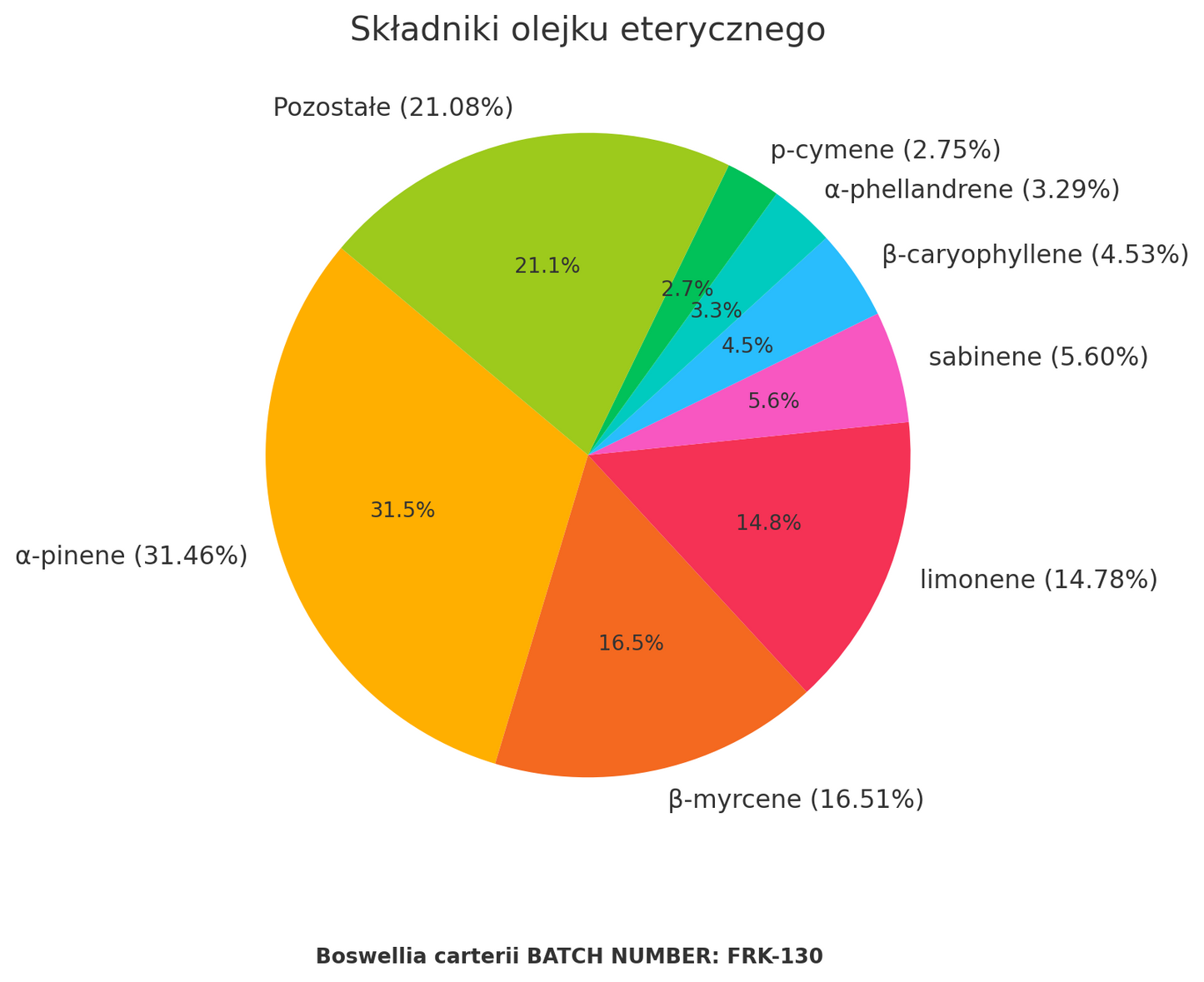
The scent of frankincense —fresh, balsamic, warm, and woody—has for centuries helped create spaces of peace and connection. This batch from Aromatics International is distinguished by its high β-myrcene content (16.51%) and developed sesquiterpene fraction, giving it a softer, more enveloping character and a deeper aftertaste compared to batches strongly dominated by α-pinene.
The presence of serratol (0.58%) is an interesting marker of heavier resin fractions – not every distillation retains this component in this proportion, which is an interesting marker of resin authenticity. Not every batch contains it.
Frankincense oil supports deep, clear breathing, especially during meditation, during cold season, or for daily respiratory health support. It's also suitable for facial care.
Sustainable Harvesting – Wild Boswellia carterii Trees
Frankincense is on our list of raw materials requiring special attention for sustainable harvesting. Our certified organic frankincense oil is produced from the resin of wild Boswellia carterii trees, native to Somaliland.
Product properties
- Country of origin: Somaliland
- Plant Part: Resin
- Cultivation: Certified organic
- Chemical family: Monoterpenes, Ethers, Esters
- Botanical family: Burseraceae
- Extraction method: Hydrodistillation
Application
Skin Care – Scars and Regeneration
Prepare a rich regenerating ointment with tamanu oil, beeswax and frankincense oil to support the care of older scars.
Relaxation – Meditation
Help your mind free itself from worries and find inner peace by diffusing frankincense oil during your meditation practice.
Breathing – Cold Season
Create an inhaler with frankincense oil and a few drops of eucalyptus to clear your airways on cold days.
Durability and safety
Shelf life: 5 years
Safety: No known hazards. A sensitivity test is recommended before first use.
The best aromatic combinations
Woody and balsamic (cedar, sandalwood, myrrh) – stabilize and deepen the relaxing effect, adding depth to the composition.
Citrus (FCF only) (bergamot, mandarin, grapefruit) – refresh, improve mood and brighten the aroma.
Floral (Damask rose, geranium, lavender) – support skin regeneration, harmonize emotions and soften the intensity of woody notes.
Herbal (eucalyptus, rosemary ct. 1,8-cineole) – cleanse the respiratory tract, support concentration and improve breathing comfort.
Party Information
- Cultivation: Certified Organic
- Production Date: 2024-09-11
- Shelf Life: 3 years
- Aroma Notes: Base
- Country of Origin: Somaliland
- Batch Number: FRK-130
View the detailed GC/MS report for this oil (PDF)
All essential oils available at Aromatics International are GC/MS tested, guaranteeing their highest quality and purity for aromatherapy applications. This ensures that we offer products with verified composition and full integrity. Learn more about GC/MS reports. Batch Number: FRK-130.
Frankincense essential oil, frankincense oil, frankincense oil, frankincense oil for wrinkles, natural frankincense oil, pure frankincense oil, true frankincense oil. (INCI: Boswellia carterii resin oil).


Najczęściej zadawane pytania
Frankincense essential oil (Boswellia carterii) is obtained by hydrodistillation from the resin of wild-growing trees from the Somaliland region. It belongs to the Burseraceae family and to the chemical groups of monoterpenes, ethers and esters. It has a fresh, balsamic, warm and woody aroma — classified as a base note. Boswellia carterii trees are included on the list of raw materials requiring particular attention in terms of sustainable harvesting — the product comes from certified, responsible harvesting. Aromatherapy using frankincense oil supports well-being and is not a method of treatment.
This batch (no. FRK-130, production date: September 2024) is distinguished by its high β-myrcene content (16.51%) and developed sesquiterpene fraction, which gives it a soft, more enveloping character and a deeper aromatic expression compared with batches strongly dominated by α-pinene. The presence of serratol (0.58%) is an interesting marker of heavier resinous fractions and the authenticity of the raw material — not every distillation retains this component in such a proportion. The composition has been confirmed by GC/MS — the full report for batch FRK-130 is available on the product page.
The Boswellia genus includes more than a dozen species — the most popular in aromatherapy are Boswellia carterii, sacra, serrata and frereana, which differ in their chemical profile, aroma and properties. Boswellia carterii from Somaliland is distinguished by a balanced profile of monoterpenes and sesquiterpenes — the high β-myrcene content gives this batch a soft, enveloping character, distinguishing it from batches dominated by α-pinene, which have a sharper, more resinous tone. A GC/MS certificate is crucial when selecting a frankincense species for specific applications. The full report for batch FRK-130 is available on the product page.
Approximately 2–4 drops per 30–60-minute session in a well-ventilated room. The oil is particularly suitable for meditation, breathing practices and evening calming rituals — it supports calm breathing and inner focus. It blends well with woody and balsamic oils (cedarwood, sandalwood, myrrh), FCF citrus oils (bergamot, mandarin, grapefruit), floral oils (Damask rose, geranium, lavender) and herbal oils (eucalyptus, rosemary ct. 1,8-cineole). Breaks between sessions are recommended.
For topical applications, the oil should be diluted in a carrier oil or cosmetic base — approximately 1–2% for facial skin, corresponding to around 6–12 drops per 30 ml of base. It is suitable for rich regenerating salves (e.g. with tamanu oil and beeswax) for scar care, and in night creams for mature skin and skin requiring regeneration. The product description indicates no known hazards when used correctly. A patch test is recommended before first use.
For a personal inhaler, approximately 3–5 drops per wick — combined with eucalyptus, it is suitable for clearing the respiratory tract during the cold and flu season. For steam inhalation, approximately 1–2 drops in a bowl of hot water. Frankincense oil supports deep, clear breathing, particularly during meditation and in the daily support of respiratory health. Aromatherapy supports well-being and does not replace medical treatment.
The product description indicates no known hazards for Boswellia carterii frankincense oil — it is one of the safer essential oils used in aromatherapy. A patch test is recommended before first use. There is insufficient clinical research regarding the safety of use during pregnancy and breastfeeding — caution and consultation with the attending physician are recommended. Aromatherapy supports well-being and does not replace medical care.
The product description does not provide detailed age guidelines for children. Boswellia carterii is generally considered one of the gentler essential oils — the absence of known hazards suggests relatively good safety. However, use in young children requires caution, low concentrations and consultation with a physician or certified aromatherapist. Diffusion in a well-ventilated room with the option to leave is less risky than topical application. The oil should be stored out of reach of children.
Boswellia carterii trees are threatened by overexploitation — intensive cutting of the bark to obtain resin weakens the trees and reduces their ability to regenerate, leading to the gradual decline of populations. AromaPremium includes frankincense on the list of raw materials requiring particular attention in terms of sustainable harvesting — the oil comes from certified, responsible harvesting in Somaliland. By choosing certified organic frankincense oil, you support practices that protect these exceptional trees for future generations.
How do I know this oil is better?
You are buying more than a scent. You are choosing purity, quality, and certainty about what enters your home. Choose an oil whose ingredients you truly know.
Discover our oils| AromaPremium Oils | Products without full transparency | |
|---|---|---|
| Confirmed purity | ||
| 100% natural ingredients | ||
| No artificial additives | ||
| Undiluted product | ||
| Known origin of plants | ||
| Product freshness | ||
| The quality of each batch | ||
| Full transparency | ||
| Greater purchasing confidence |

Your trust is very important to us
To ensure full quality transparency, we provide GC/MS reports for each oil.
GC/MS tests confirm the purity and authentic chemical composition of the oils , so you can be sure that you are using the highest quality products.
To view the GC/MS report for a given oil, simply click the PDF available on the product page. We publish GC/MS reports for individual oil batches one by one.
For each oil, we have also prepared a graphical summary of the composition in the form of a pie chart , which makes it easier to understand the chemical profile of the batch.
⚖️ Aromatherapy quality
Aromatherapy AI Assistant

Original products sourced from verified suppliers
Choose authentic essential oils – avoid unverified or unknown sources

Customer satisfaction is our priority