



Aromatics International
Rosemary essential oil ct verbenone (Rosmarinus officinalis ct verbenone/Salvia rosmarinus) – organic
Rosemary essential oil ct verbenone (Rosmarinus officinalis ct verbenone/Salvia rosmarinus) – organic
Couldn't load pickup availability

Rosemary ct Verbenone Essential Oil (Rosmarinus officinalis ct verbenone/Salvia rosmarinus)
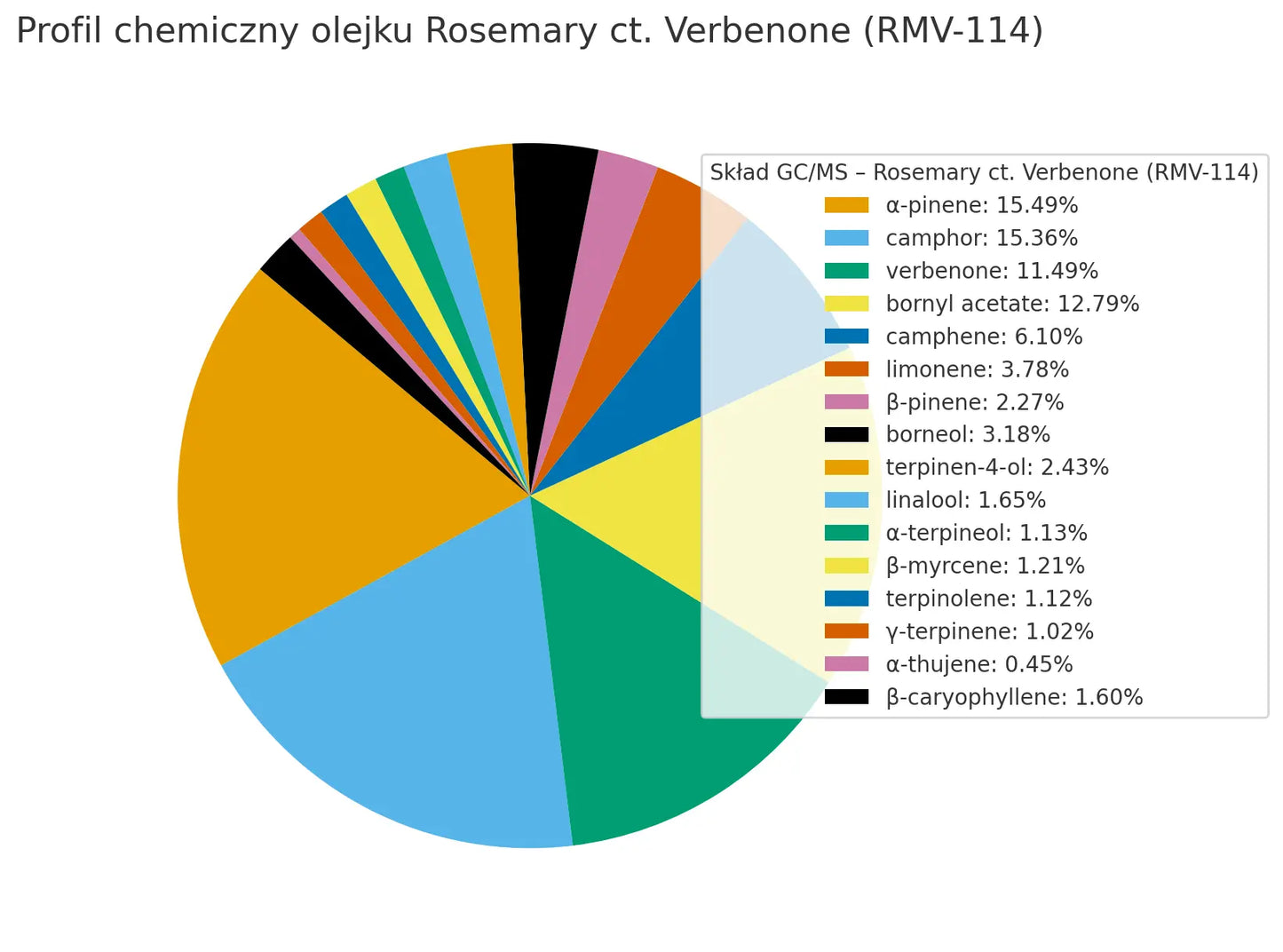
Certified Organic Rosemary essential oil. Verbenone is a rare South African chemotype with exceptionally high verbenone (11.49%) and bornyl acetate (12.79%) content—a testament to ideal harvesting and distillation conditions. This balance allows RMV-114 to combine cleansing power with gentle conditioning, making it a versatile yet luxurious rosemary.
It delights with its balanced aroma—fresh yet warm, balsamic, and gentle on the skin. It supports cellular regeneration, body cleansing, and mental focus, offering a subtle energy of renewal in every drop.
This oil has a more refined, balsamic-woody character, in which the camphor note doesn't dominate but rather blends into the background. The aroma is warm, deep, and elegant – compared to the sharper profile of ct. cineole or ct. camphor.
Rosemary ct. verbenone is one of the most frequently recommended essential oils for scalp care, but for very specific reasons and with certain safety guidelines. Gentle, it supports the regeneration of skin cells and hair follicles. Its high verbenone and bornyl acetate content stimulates microcirculation without irritating the skin.
Our certified organic rosemary verbenone essential oil is obtained by steam distillation from the flowers and leaves of plants grown in South Africa.
Product properties
Country of origin: South Africa
Part of the plant: Aboveground part
Cultivation: Certified organic
Groups of organic compounds: Monoterpenes, Oxides, Ketones
Botanical family: Lamiaceae
Extraction method: Steam distillation
Therapeutic and aromatic properties
Therapeutic properties:
- Painkillers
- Antifungal
- Astringent
- Antimicrobial
- Skin regenerating
- Mucolytic (Immunostimulating)
Fragrance profile:
- Notes: Top-middle
- Aroma: Fresh, Herbal, Camphor
Application
Relief – soreness/tenderness
Make a knee gel: mix rosemary ct. verbenon with aloe gel and apply as needed. Proportions (adults): 1–2% = 6–12 drops of oil per 30 ml of gel.
Skin care
Reduce blemishes without alcohol or harsh soaps. Mix rosemary with aloe vera gel and hemp oil; use as a gentle cleanser.
Recommendation: 20 ml aloe gel + 10 ml hemp oil + 6 drops of rosemary (approx. 1%); massage gently, rinse with lukewarm water.
Breathing – obstruction / “stuffy nose”
When you have a big project coming up and you're distracted by runny nose symptoms, prepare an inhaler with rosemary ct. verbenon. Proportions: 8–12 drops per inhaler cartridge; inhale 2–3 times daily in short bursts.
Safety and warnings
If the oil oxidizes, it may cause skin irritation or allergic reactions; store tightly closed, cool, and away from light. Literature indicates that people with epilepsy and pregnant women should avoid rosemary due to its camphor content; it can also be a stimulant oil, so it is best not to use it at night. For children, use a concentration no higher than 1% (approximately 5–6 drops per 1 ounce/30 ml of carrier). However, according to "Essential Oil Safety" by Tisserand and Young (2nd ed.), there is no basis for generally contraindicating any essential oil for people with hypertension.
Differences between rosemary (Rosmarinus officinalis) essential oils:
| Chemotype | Main components (GC/MS) | Main properties | For whom / application | Comments |
|---|---|---|---|---|
| ct. cineole (1,8-cineole) | 1,8-cineole (eucalyptol), α-pinene, camphor | Expectorant, antibacterial, supports breathing | Colds, coughs, concentration | The most stimulating, "eucalyptus" type |
| ct. camphor | camphor, borneol, camphene | Analgesic, warming, stimulates circulation | Muscle pain, rheumatism, fatigue | Strong, sharp scent – not for sensitive skin or pregnant women |
| ct. verbenone | verbenone, bornyl acetate, camphor, α-pinene | Regenerating, cell renewal, gentler on the skin | Skin care, liver, lymphatic system | The most gentle and detoxifying chemotype |
| ct. α-pinene (less common) | α-pinene, camphene, limonene | Antiseptic, stimulating | Mixtures for learning and concentration | The freshest, pine-herbal tone |
Country of Origin: South Africa
Cultivation: Certified Organic
Production Date: 2024-05-24
Shelf Life: 5 years
Aroma Notes: Top-middle
Batch Number: RMV-114
View the detailed GC/MS report for this oil ( PDF ).
All essential oils available at Aromatics International are GC/MS tested, guaranteeing their highest quality and purity for aromatherapy applications. This ensures that we offer products with verified composition and full integrity. Learn more about GC/MS reports. Batch Number: RMV-114 .


How do I know this oil is better?
You are buying more than a scent. You are choosing purity, quality, and certainty about what enters your home. Choose an oil whose ingredients you truly know.
Discover our oils| AromaPremium Oils | Products without full transparency | |
|---|---|---|
| Confirmed purity | ||
| 100% natural ingredients | ||
| No artificial additives | ||
| Undiluted product | ||
| Known origin of plants | ||
| Product freshness | ||
| The quality of each batch | ||
| Full transparency | ||
| Greater purchasing confidence |

Your trust is very important to us
To ensure full quality transparency, we provide GC/MS reports for each oil.
GC/MS tests confirm the purity and authentic chemical composition of the oils , so you can be sure that you are using the highest quality products.
To view the GC/MS report for a given oil, simply click the PDF available on the product page. We publish GC/MS reports for individual oil batches one by one.
For each oil, we have also prepared a graphical summary of the composition in the form of a pie chart , which makes it easier to understand the chemical profile of the batch.
⚖️ Aromatherapy quality
Aromatherapy AI Assistant

Original products sourced from verified suppliers
Choose authentic essential oils – avoid unverified or unknown sources

Customer satisfaction is our priority