



Destylarnia Vessel
Rosemary essential oil ct 1,8-Cineole (Rosmarinus officinalis ct 1,8-Cineole) – organic
Rosemary essential oil ct 1,8-Cineole (Rosmarinus officinalis ct 1,8-Cineole) – organic
Couldn't load pickup availability

Rosemary essential oil (Rosmarinus officinalis) boasts a distinctive chemical profile that supports concentration, mental clarity, and breathing comfort. At the same time, its fresh, herbal-camphorate character makes it well-suited for aromatherapy for mental fatigue, low energy, mental overload, and the need for stimulation without being heavy and irritating.
Certified Organic Greek Rosemary Essential Oil – Chemotype 1,8-Cineole
Certified organic rosemary essential oil (Rosmarinus officinalis), chemotype 1,8-cineole, is distinguished by a very distinctive chemical profile dominated by monoterpenes, monoterpene oxides, and monoterpene ketones. GC analysis of this batch shows that the oil has a distinctly fresh, bright, herbal, and slightly camphoraceous character, typical of authentic rosemary ct 1,8-cineole distilled from the aerial parts of the plant.
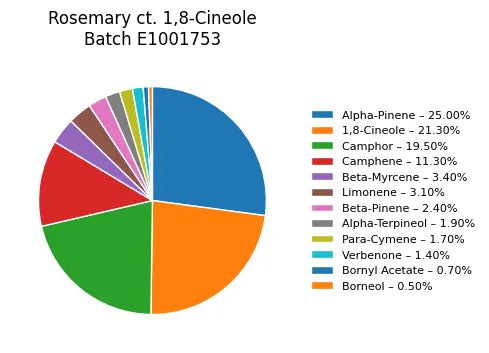
The largest component is α-pinene (25.00%) , a monoterpene. This compound is responsible for the fresh, needle-green aroma and the oil's slightly stimulating, cleansing character. In aromatherapy, monoterpenes from this group are valued for their ability to support concentration, fresh breath, and an overall sense of cleanliness in a space. Combined with camphene (11.30%) , β-myrcene (3.40%) , limonene (3.10%) , and β-pinene (2.40%), they create a distinctly activating, dynamic, and clear profile.
The second important chemical component of the oil is 1,8-cineole (21.30%) , a monoterpene oxide. It is responsible for the fresh, penetrating, and respiratory character of rosemary. In aromatherapy, this group of compounds is primarily associated with supporting mental clarity, concentration, and respiratory comfort, which is why this chemotype is particularly valued in diffusion, inhalation, and blends for mental work.
Camphor (19.50%) , a member of the monoterpene ketone group, also plays a significant role in the oil's profile. It gives the oil a more dry, cool, and slightly medicinal note. The presence of camphor enhances the sensation of freshness and makes the oil suitable for use in compositions for muscle massage, post-exercise care, and in blends promoting a feeling of freer breathing.
The combination of high monoterpene, 1,8-cineole, and camphor content gives this batch of rosemary oil a distinctly fresh, stimulating, and functional profile. Its aroma is energizing and "breathable," making it well-suited for both everyday aromatherapy and applications aimed at promoting concentration, activity, and recovery after exercise. In aromatherapy, it can be used in blends supporting mental clarity and stimulation, as well as in respiratory, cleansing, and muscle-regenerative compositions.
Product properties
- Country of origin: Greece
- Part of the plant: Aboveground parts
- Cultivation: Certified organic
- Groups of organic compounds: Monoterpenes, Oxides, Ketones
- Botanical family: Lamiaceae
- Extraction method: Steam distillation
Therapeutic properties
- Supporting concentration and mental clarity
- Helpful for mental fatigue and energy loss
- Supporting breathing comfort and a feeling of freshness
- Helpful in mixes for work, study and concentration
- Used in aromatherapy for muscle tension and fatigue after exercise.
- Cleansing the atmosphere of the room
- Stimulating and activating without being heavy or sweet.
Fragrance profile
- Aroma: fresh, herbal, camphorous, clear, slightly coniferous
- Fragrance classification: top to middle note
- Appearance: clear, mobile liquid
- Color: colorless to light yellow
Chemical profile – dominant ingredients
Alpha-Pinene – 25.00%
1.8-Cineola – 21.30%
Camphor – 19.50%
Camphene – 11.30%
Beta-Myrcene – 3.40%
Limonene – 3.10%
Beta-Pinene – 2.40%
Alpha-Terpineol – 1.90%
Para-Cymene – 1.70%
Verbenone – 1.40%
Bornyl Acetate – 0.70%
Borneol – 0.50%
Application
Concentration – mental work and learning
Rosemary essential oil ct 1,8-cineole works well when diffused during work, study, and intense intellectual activity. Its fresh, penetrating aroma helps create an atmosphere of focus, alertness, and mental mobilization.
Breath – freshness and space
Thanks to the presence of 1,8-cineole and monoterpenes, this oil is often used in respiratory aromatherapy. It can be used in a diffuser or through indirect inhalation when you want to freshen the air and improve breathing comfort.
Body – massage after exercise and tension
Diluted in a carrier oil, it can be used in massage blends for muscle tension, stiffness, and physical fatigue. Camphor and fresh monoterpenes give it a profile particularly useful in activating and regenerative compositions.
Security
Tisserand and Young warn that rosemary oil may have potential neurotoxic effects (therefore, its use is avoided in individuals with epilepsy). They recommend a maximum dermal concentration of 22% for this chemotype. Both recommendations are based on the camphor content of the oil. It is recommended to review the full safety profile described by Tisserand and Young.
Storage and shelf life
Shelf life: 5 years
Store in a dark, cool and dry place, in a tightly closed container, away from light and heat sources.
Combinations for rosemary oil ct 1,8-cineole
Very harmonious: Lavender, cypress, frankincense, peppermint, eucalyptus radiata, geranium.
Fresh aromatherapy blends: Lemon, bergamot, grapefruit, lime, mandarin.
Herbal-cleansing compositions: Pine, juniper, ravintsara, oregano in small quantities, thyme ct. linalool.
Respiratory health: ravintsara, sweet inula, menthol eucalyptus, niaouli.
Nervous and physical fatigue: black spruce, ravintsara, peppermint.
Party Information
Production date: December 2024
Expiration date: December 2029
Batch number: E1001753
Country of origin: Greece
Quality guarantee – GC/MS and GC/FID tests
Vessel essential oils are tested using GC/MS and GC/FID methods, confirming their authenticity, purity and compliance with the natural plant profile.
The analysis utilizes gas chromatography combined with mass spectrometry (GC/MS) in SCAN mode to precisely identify each component. Quantitative composition is determined using GC/FID. This ensures that we offer only natural oils, free from synthetic additives—ideal for professional aromatherapy applications. The distillery specializes in medicinal and aromatic plants (MAP) and complies with ISO 9001/22000 and Organic/COSMOS standards, among others.
Rosemary oil, rosemary breathing oil, rosemary oil, rosemary for stimulation (INCI: Rosmarinus Officinalis Leaf Oil)


How do I know this oil is better?
You are buying more than a scent. You are choosing purity, quality, and certainty about what enters your home. Choose an oil whose ingredients you truly know.
Discover our oils| AromaPremium Oils | Products without full transparency | |
|---|---|---|
| Confirmed purity | ||
| 100% natural ingredients | ||
| No artificial additives | ||
| Undiluted product | ||
| Known origin of plants | ||
| Product freshness | ||
| The quality of each batch | ||
| Full transparency | ||
| Greater purchasing confidence |

Your trust is very important to us
To ensure full quality transparency, we provide GC/MS reports for each oil.
GC/MS tests confirm the purity and authentic chemical composition of the oils , so you can be sure that you are using the highest quality products.
To view the GC/MS report for a given oil, simply click the PDF available on the product page. We publish GC/MS reports for individual oil batches one by one.
For each oil, we have also prepared a graphical summary of the composition in the form of a pie chart , which makes it easier to understand the chemical profile of the batch.
⚖️ Aromatherapy quality
Aromatherapy AI Assistant

Original products sourced from verified suppliers
Choose authentic essential oils – avoid unverified or unknown sources

Customer satisfaction is our priority