



Destylarnia Vessel
Ravintsara essential oil ct 1,8-cineole (Cinnamomum camphora) organic
Ravintsara essential oil ct 1,8-cineole (Cinnamomum camphora) organic
Couldn't load pickup availability

Ravintsara ct. 1,8-cineole essential oil supports free breathing, natural immunity, and mental clarity, especially during periods of infection and weakness. Additionally, it has a refreshing and energizing effect, making it suitable for diffusion, inhalations, and blends that promote concentration and regeneration.
Ravintsara ct 1,8-cineole Essential Oil (Cinnamomum camphora)
Organic ravintsara oil from Madagascar – 1,8-cineole chemotype
Organic Ravintsara essential oil (Cinnamomum camphora chemotype 1,8-cineole), also known as Ho Leaf CT cineole, and in Japan as yu-sho or camphor oil tree. The fresh and clean aroma of Ravintsara essential oil strongly resembles eucalyptus. Both oils share the same main component – 1,8-cineole, which is responsible for their clear, stimulating effect.
Ravintsara supports free breathing, natural immunity during cold season, and mental clarity, providing energy when the body needs support in colder months. Madagascan ravintsara – with a well-balanced profile and approximately 48% 1,8-cineole – has antiviral and immunostimulating properties, while also being gentler than Eucalyptus globulus. Ideal for diffusion during periods of increased infections, for personal inhalers, and for compositions promoting concentration and regeneration after illness.
Unique origin – only from Madagascar
Although camphor trees are native to Taiwan, China, and Japan, Ravintsara essential oil in its therapeutic form is obtained exclusively from the leaves of trees cultivated in Madagascar – in regions with a specific microclimate that favors a high content of 1,8-cineole and low camphor, making it one of the purest eucalyptus oils in the world.
Important: Ravintsara (Cinnamomum camphora) was for many years confused with ravensara (Ravensara aromatica) – an oil with a completely different biochemical composition and properties. This confusion persisted in older publications and catalogs, which is why today it is always necessary to pay attention to the botanical name and chemotype.
Product properties
- Country of origin: Madagascar
- Part of plant: Leaves
- Cultivation: Organic
- Groups of organic compounds: Monoterpenes, monoterpene alcohols (monoterpenols), oxides
- Botanical family: Lauraceae
- Extraction method: Steam distillation
Therapeutic properties
- Antiviral and immunostimulating
- Supports breathing and airway patency
- Antimicrobial and antiseptic
- Energizing and mind-clearing
- Supports concentration
- Regenerating after illness
Scent profile
- Aroma: fresh, clean, slightly camphoraceous, with a hint of eucalyptus and earthy notes
- Scent classification: middle
- Appearance: liquid
- Color: colorless to pale yellow
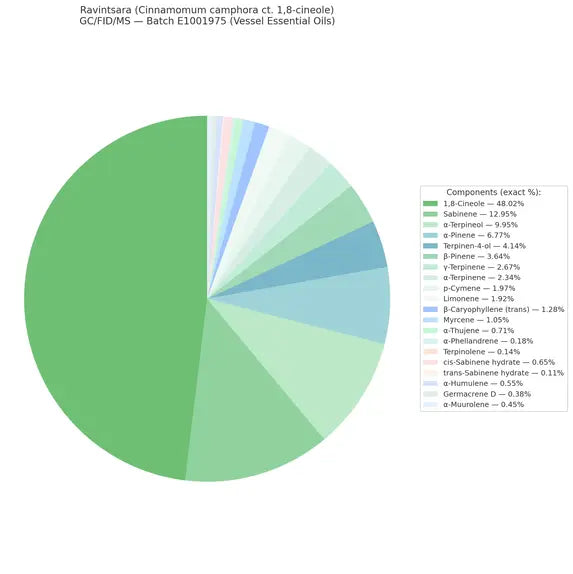
Chemical profile – dominant components
- 1,8-Cineole – 48.02%
- Sabinene – 12.95%
- α-Terpineol – 9.95%
- α-Pinene – 6.77%
- Terpinen-4-ol – 4.14%
- β-Pinene – 3.64%
- γ-Terpinene – 2.67%
- α-Terpinene – 2.34%
- p-Cymene – 1.97%
- Limonene – 1.92%
- β-Caryophyllene – 1.28%
- Myrcene – 1.05%
Application
Breathing – cold season
Open your breath and clear your head. Add 1 drop of ravintsara oil to hot (not boiling) water and gently inhale the steam for a few minutes.
Purification – support during infectious periods
Help purify the air and support the body's natural defense mechanisms by diffusing ravintsara – especially when cold symptoms appear.
Energy – concentration and energy
Fatigue and distraction? Make a personal inhaler with ravintsara to regain clarity and focus during the day.
Safety
Safety and warnings:
- If oxidized, it may cause irritation or allergic reactions
- It may also weaken the effect of homeopathic preparations
- It is too strong for use in infants and children under 10 years of age – especially on the face or in steam inhalations
- In children aged 5-10 years, it should be used with caution
- Special caution should also be exercised in people with asthma
Storage and shelf life
Shelf life: 5 years
Store in a dark, cool place, away from sunlight.
Blends for ravintsara oil
For immunity:
- Combine ravintsara with eucalyptus radiata and a hint of Scots pine, Mediterranean cypress, or black spruce – to support breathing and the body's natural defense mechanisms
For concentration:
- Combine the fresh clarity of ravintsara with lemon and rosemary. This forest-citrus aroma clears thoughts, organizes attention, and provides energy for action
For nervous tension:
- Reach for a soothing combination: ravintsara with soft bergamot and enveloping lavender. The delicate, harmonizing composition helps calm tension and restores lightness to breath
Batch information
- Production date: June 2025
- Expiration date: June 2030
- Batch number: E1001975
Laboratory testing
Ensuring full quality transparency, we provide laboratory documentation for each oil, including GC/MS reports and SDS/MSDS sheets. The tests confirm the authenticity, purity, and chemical profile of a given batch, and PDF files and graphic summaries of the composition are published on the product page.
Quality guarantee – GC/MS and GC/FID tests
Vessel brand essential oils are tested using GC/MS and GC/FID methods, which confirms their authenticity, purity, and compliance with the natural profile of the plant.
The analysis uses gas chromatography coupled with mass spectrometry (GC/MS) in SCAN mode to precisely identify each component. Quantitative composition is determined by GC/FID. This ensures that we offer only natural oils, without synthetic additives – ideal for professional aromatherapy applications. The distillery specializes in medicinal and aromatic plants (MAP). It operates, among others, under ISO 9001/22000 and Organic/COSMOS standards.
(INCI: Cinnamomum camphora leaf oil)


How do I know this oil is better?
You are buying more than a scent. You are choosing purity, quality, and certainty about what enters your home. Choose an oil whose ingredients you truly know.
Discover our oils| AromaPremium Oils | Products without full transparency | |
|---|---|---|
| Confirmed purity | ||
| 100% natural ingredients | ||
| No artificial additives | ||
| Undiluted product | ||
| Known origin of plants | ||
| Product freshness | ||
| The quality of each batch | ||
| Full transparency | ||
| Greater purchasing confidence |

Your trust is very important to us
To ensure full quality transparency, we provide GC/MS reports for each oil.
GC/MS tests confirm the purity and authentic chemical composition of the oils , so you can be sure that you are using the highest quality products.
To view the GC/MS report for a given oil, simply click the PDF available on the product page. We publish GC/MS reports for individual oil batches one by one.
For each oil, we have also prepared a graphical summary of the composition in the form of a pie chart , which makes it easier to understand the chemical profile of the batch.
⚖️ Aromatherapy quality
Aromatherapy AI Assistant

Original products sourced from verified suppliers
Choose authentic essential oils – avoid unverified or unknown sources

Customer satisfaction is our priority