



AromaPremium
Yarrow (Achillea millefolium) Essential Oil, certified organic
Yarrow (Achillea millefolium) Essential Oil, certified organic
Couldn't load pickup availability

Yarrow essential oil intensely soothes reactive, sensitive, and redness-prone skin, supporting its regeneration and comfort thanks to its high chamazulene content. Additionally, in aromatherapy, it has a harmonizing and emotionally stabilizing effect, helping with tension and nervous system overload.
Common Yarrow (Blue) Organic Essential Oil (Achillea millefolium)
Certified Organic Blue Yarrow Essential Oil – High Chamazulene 7.3%
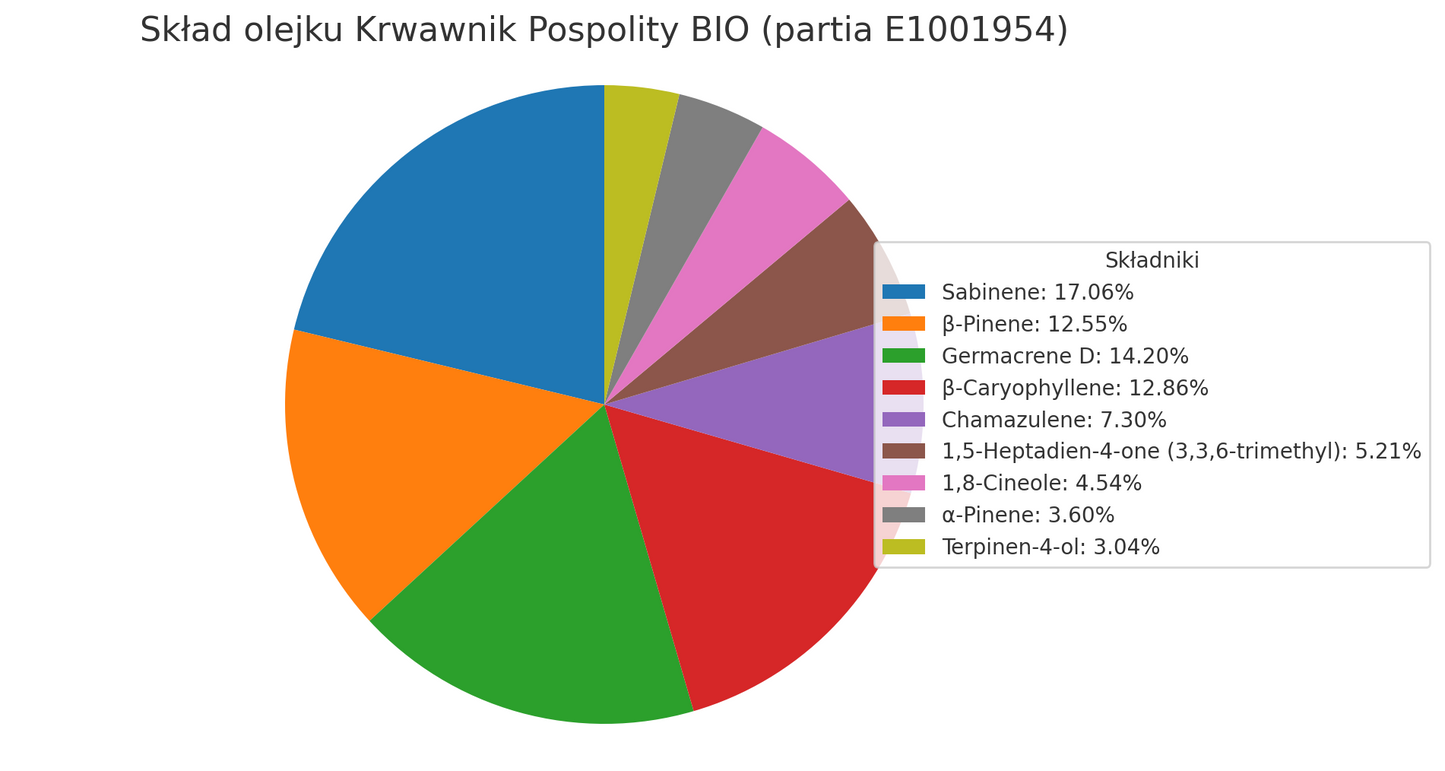
Certified organic common yarrow (Achillea millefolium) essential oil, obtained from the leaves and flowering tops of plants organically grown in the Chalkidiki region and steam-distilled. An interesting batch of organic Yarrow with high chamazulene content of 7.3% (hence its deep blue color and strong soothing properties). The GC profile is very "skin-friendly," with fresh monoterpene accords: sabinene 17.06%, β-pinene 12.55%, high sesquiterpene content: germacrene D 14.2%, β-caryophyllene 12.86%, with a hint of 1.8-cineole 4.54% and trace ketones.
Our blue yarrow with 7.3% chamazulene and a wealth of sesquiterpenes (germacrene D, β-caryophyllene); exceptionally soothing for reactive and redness-prone skin.
Product properties
- Country of origin: Chalkidiki, Central Macedonia
- Plant part: Flowering tops and leaves
- Cultivation: Certified organic
- Organic compound groups: Monoterpenes, sesquiterpenes
- Botanical family: Asteraceae (Compositae)
- Extraction method: Steam distillation
Therapeutic properties
- Intensely soothing for reactive and sensitive skin
- Reduces redness and irritation
- Regenerates and supports the skin barrier
- Balancing for combination and oily skin
- Toning for blood vessels
- Harmonizing and emotionally stabilizing
- Supports relief from nervous system tension
Scent profile
- Aroma: herbaceous, camphoraceous, rich, with a bittersweet undertone and floral notes
- Scent classification: top to middle
- Appearance: light, liquid
- Color: dark blue
Chemical profile – dominant components
- Sabinene – 17.06%
- Germacrene D – 14.2%
- β-caryophyllene – 12.86%
- β-pinene – 12.55%
- Chamazulene – 7.30%
- 1,5-heptadien-4-one (3,3,6-trimethyl) – 5.21%
- 1,8-cineole – 4.54%
- α-pinene – 3.60%
- Terpinen-4-ol – 3.04%
Application
SOS for reactive/rosacea skin
Soothes redness, "itchy" skin, minor irritations (chamazulene + sesquiterpenes).
Balance and smoothing
For combination/oily skin (germacrene D, β-caryophyllene "comfort" and barrier support).
Scalp
Tonics/serums for sensitive, irritated skin; blends well with rosemary ct verbenone.
Evening rituals
Combines skin soothing with subtle, green relaxation in a diffuser.
Safety
Safety and warnings:
- Drug interactions: Tisserand and Young recommend caution when using yarrow essential oil. They indicate that this oil may interact with drugs metabolized by the CYP2D6 enzyme.
- Neurotoxicity: May exhibit slight neurotoxicity.
- Concentration: The maximum allowable concentration for skin application is 8.6%.
- External use: For external use and room aromatization only.
- Dilution: Dilute before application.
- Damaged skin: Do not apply to damaged skin, near eyes, or mucous membranes.
- Storage: Store tightly sealed, away from heat and light sources.
Storage and shelf life
Shelf life: 5 years
Store in a dark, cool place, away from sunlight.
Blends for yarrow oil
Sensitive skin / redness:
- German Chamomile (blue), Immortelle (Helichrysum italicum), Lavender
Soothing-regenerating serum:
- Frankincense (Boswellia), Geranium, Palmarosa
Capillaries / toning:
- Cypress, Immortelle (Helichrysum italicum), Frankincense
Combination skin balance:
- Niaouli or Eucalyptus Radiata (gently), Tea Tree (trace), Palmarosa
Diffuser relaxation:
- Bergamot, Green/Red Mandarin, Atlas Cedar
Muscles / overload:
- Sweet Marjoram, Rosemary ct. cineole (sparingly), Juniper
Batch information
- Production date: July 2025
- Expiry date: July 2030
- Batch no.: E1001954
Laboratory testing
To ensure full transparency of quality, we provide laboratory documentation for each oil, including GC/MS reports and SDS/MSDS sheets. The tests confirm the authenticity, purity, and chemical profile of each batch, and PDF files and graphical summaries of the composition are published on the product page.
Quality assurance – GC/MS and GC/FID tests
Vessel brand essential oils are tested using GC/MS and GC/FID methods, which confirms their authenticity, purity, and consistency with the natural plant profile.
The analysis utilizes gas chromatography coupled with mass spectrometry (GC/MS) in SCAN mode to precisely identify each component. Quantitative composition is determined by GC/FID. This ensures that we offer only natural essential oils, without synthetic additives – ideal for professional aromatherapy applications. The distillery specializes in medicinal and aromatic plants (MAP). It operates, among others, according to ISO 9001/22000 and Organic/COSMOS standards.
(INCI: Achillea millefolium Oil)


How do I know this oil is better?
You are buying more than a scent. You are choosing purity, quality, and certainty about what enters your home. Choose an oil whose ingredients you truly know.
Discover our oils| AromaPremium Oils | Products without full transparency | |
|---|---|---|
| Confirmed purity | ||
| 100% natural ingredients | ||
| No artificial additives | ||
| Undiluted product | ||
| Known origin of plants | ||
| Product freshness | ||
| The quality of each batch | ||
| Full transparency | ||
| Greater purchasing confidence |

Your trust is very important to us
To ensure full quality transparency, we provide GC/MS reports for each oil.
GC/MS tests confirm the purity and authentic chemical composition of the oils , so you can be sure that you are using the highest quality products.
To view the GC/MS report for a given oil, simply click the PDF available on the product page. We publish GC/MS reports for individual oil batches one by one.
For each oil, we have also prepared a graphical summary of the composition in the form of a pie chart , which makes it easier to understand the chemical profile of the batch.
⚖️ Aromatherapy quality
Aromatherapy AI Assistant

Original products sourced from verified suppliers
Choose authentic essential oils – avoid unverified or unknown sources

Customer satisfaction is our priority