



Destylarnia Vessel
Anise Essential Oil (Pimpinella anisum) natural
Anise Essential Oil (Pimpinella anisum) natural
Couldn't load pickup availability

Anise essential oil supports digestive comfort and relaxation of abdominal tension, while bringing a warm, enveloping sense of calm. Additionally, it has a clarifying and energizing effect on the mind, thanks to the fresh, lighter version of the classic anise aroma.
Anise Essential Oil (Pimpinella anisum)
Anise essential oil from Greece – a fresh, citrusy-sparkling aura
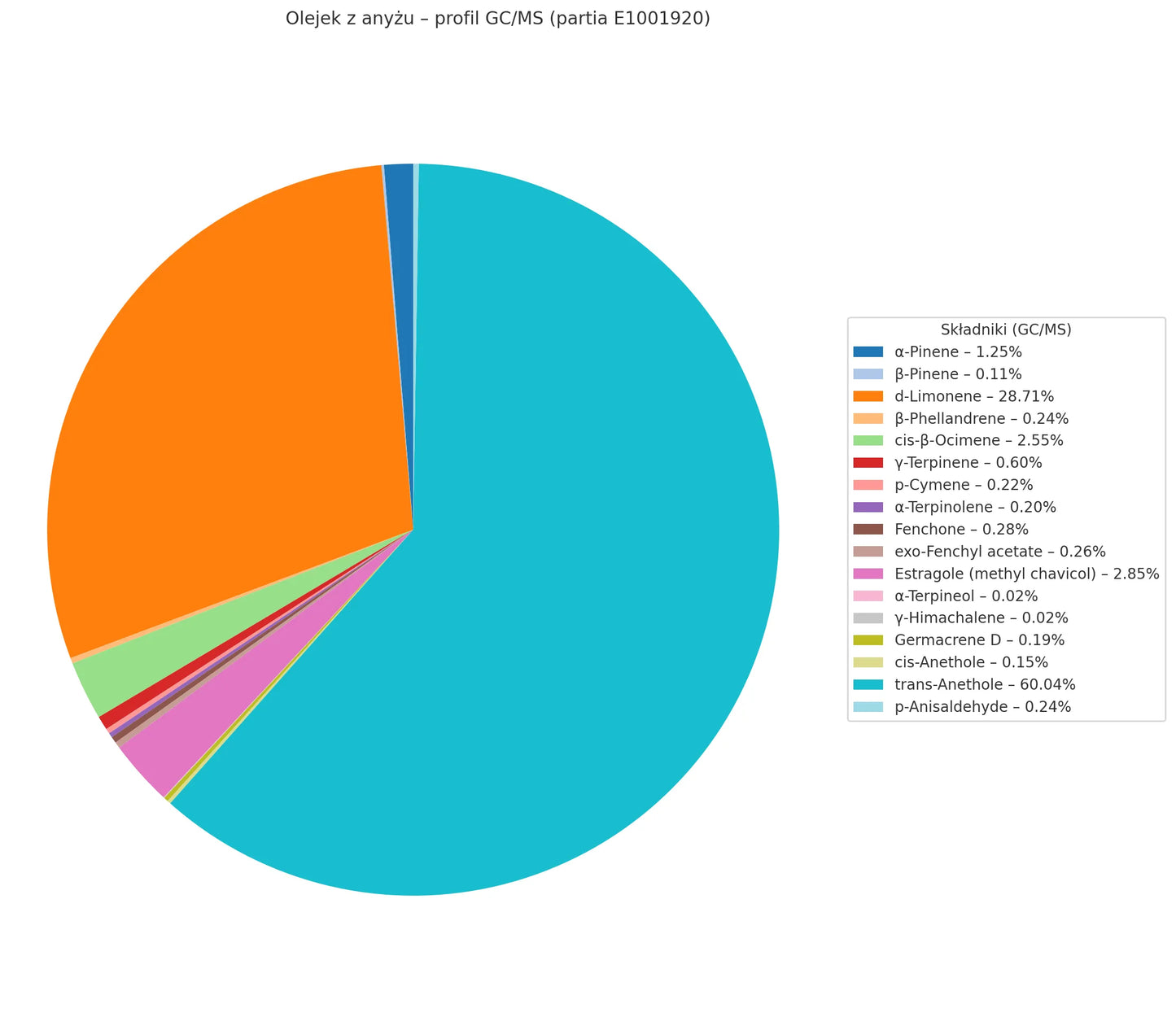
100% pure & natural anise essential oil (Pimpinella anisum) is obtained by steam distillation from mature, brown seeds of anise flowers, grown in the Eastern Mediterranean region. It is a species typical of this area – naturally occurring in Greece and Southwest Asia. This anise has a surprisingly fresh, "citrusy-sparkling" aura. A high proportion of d-limonene (28.7%) lifts the composition and adds lightness, making the first impression fresher than typically licorice-like. At the same time, trans-anethole is moderate (60%), the scent remains clear, clean, with a nice brightness at the top. Estragole at a low level (2.85%).
Anise with a distinct, sweet profile with a classic "licorice" note and a delicate fennel accent. It opens brightly and freshly, then transitions into a pleasant, enveloping warmth. It works perfectly as a luminous "spark" in citrus compositions, as well as in accords with a sweeter base and in classic, herbal-woody arrangements. If you prefer a very classic, licorice-syrupy character – choose a batch with higher anethole; this version is crisper.
Anise essential oil relieves symptoms of nervous digestive tract disorders. In aromatherapy, it is used for: cough, bronchitis, rhinitis, flatulence, intestinal spasms, indigestion, migraines, and headaches related to digestion.
Product properties
- Country of origin: Greece
- Part of plant: Mature, dry seeds
- Cultivation: Conventional
- Organic compound groups: Ethers
- Botanical family: Apiaceae (Umbelliferae)
- Extraction method: Steam distillation
Therapeutic properties
- Antispasmodic and digestive aid
- Relieves bloating and abdominal tension
- Aids with nausea and motion sickness
- Relaxes muscle spasms
- Clarifying and energizing for the mind
- Emotionally enveloping and soothing
Scent profile
- Aroma: characteristic, intensely sweet, licorice-fennel, with a citrus nuance
- Scent classification: top to middle note
- Appearance: liquid
- Color: colorless to pale yellow
Chemical profile – dominant components
- Trans-anethole – 60.04% (phenylpropanoid)
- d-Limonene – 28.71% (monoterpene)
- Estragole (methyl chavicol) – 2.85%
- Cis-β-ocimene – 2.55%
- α-pinene – 1.25%
- α-phellandrene – 1.08%
- p-anisaldehyde – 0.24%
Application
Digestion – Bloating
Gentle diffusion of anise can help relax abdominal tension and restore comfort after a meal. Use sparingly – it is an intense aroma.
Digestion – Nausea / Motion sickness
Inhale briefly when you feel discomfort: a tissue with 1 drop of anise (optionally + 1 drop of tangerine).
Relief – Intestinal spasms
For local massage, prepare a blend: 1–2 drops of anise per 10 ml of carrier oil. Massage topically into tense areas, using slow movements.
Safety
Safety and warnings:
- Estrogen-like activity: "Essential Oil Safety" by Tisserand and Young (2nd ed.) states that trans-anethole exhibits (slight) estrogen-like activity and is contraindicated during pregnancy, breastfeeding, in cases of endometriosis, estrogen-dependent cancers, and in children under 5 years of age
- Drug interactions: May interact with anticoagulant medications or be problematic in cases of clotting disorders
- Oxidation: May act as a skin sensitizer after oxidation
- Concentration: For topical applications, a maximum dilution of 2.4% is recommended
Storage and shelf life
Shelf life: 5 years
Store in a dark, cool place, away from sunlight.
Blends for anise essential oil
- Mandarin / bergamot – brighten and add a luminous opening
- Lavender – softens the "temperament" of anise, introduces calm and elegance
- Cardamom – enhances warmth and rounds out sweetness without heaviness
- Atlas cedar – anchors the composition, provides background and depth
Batch information
- Production date: July 2025
- Expiration date: July 2030
- Batch number: E1001920
Anise curiosity
Anise from seeds (Pimpinella anisum) and star anise (Illicium verum) smell similar due to anethole, but they are different species: the first is the seeds of a herbaceous plant from Europe/Mediterranean, the second – star-shaped fruits of a tree from Asia.
Quality assurance – GC/MS and GC/FID tests
Vessel brand essential oils are tested using GC/MS and GC/FID methods, confirming their authenticity, purity, and compliance with the natural plant profile.
Gas chromatography coupled with mass spectrometry (GC/MS) in SCAN mode is used in the analysis to precisely identify each component. Quantitative composition is determined by GC/FID. This ensures that we offer only natural essential oils, without synthetic additives – ideal for professional aromatherapy applications. The distillery specializes in medicinal and aromatic plants (MAP). It operates, among others, in ISO 9001/22000 and Organic/COSMOS standards.
(INCI: Pimpinella anisum seed oil)


How do I know this oil is better?
You are buying more than a scent. You are choosing purity, quality, and certainty about what enters your home. Choose an oil whose ingredients you truly know.
Discover our oils| AromaPremium Oils | Products without full transparency | |
|---|---|---|
| Confirmed purity | ||
| 100% natural ingredients | ||
| No artificial additives | ||
| Undiluted product | ||
| Known origin of plants | ||
| Product freshness | ||
| The quality of each batch | ||
| Full transparency | ||
| Greater purchasing confidence |

Your trust is very important to us
To ensure full quality transparency, we provide GC/MS reports for each oil.
GC/MS tests confirm the purity and authentic chemical composition of the oils , so you can be sure that you are using the highest quality products.
To view the GC/MS report for a given oil, simply click the PDF available on the product page. We publish GC/MS reports for individual oil batches one by one.
For each oil, we have also prepared a graphical summary of the composition in the form of a pie chart , which makes it easier to understand the chemical profile of the batch.
⚖️ Aromatherapy quality
Aromatherapy AI Assistant

Original products sourced from verified suppliers
Choose authentic essential oils – avoid unverified or unknown sources

Customer satisfaction is our priority