


Destylarnia Vessel
Balsam Fir (Abies balsamea) Essential Oil
Balsam Fir (Abies balsamea) Essential Oil
Couldn't load pickup availability

Balsam fir essential oil combines the intense freshness of a Canadian forest with a delicate, balsamic softness. The aroma is green, resinous and slightly citrusy, light, volatile, intensely aromatic and quickly spreads in the air. It refreshes, cleanses and energises – recommended for fatigue, overload and the need to purify the atmosphere.
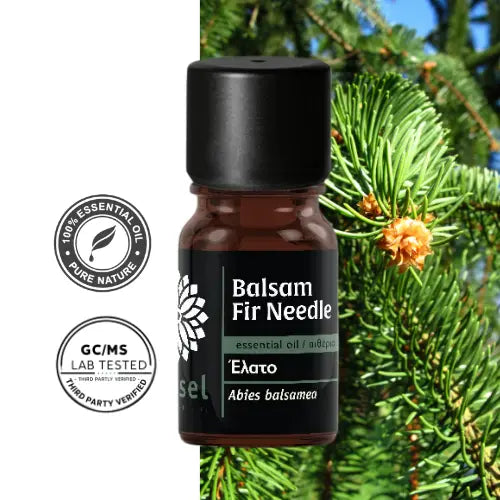
Balsam Fir Needle Essential Oil (Abies balsamea)
Balsam Fir Essential Oil – from Canada, rich in β-pinene, δ-3-carene, and bornyl acetate
Balsam fir essential oil has a fresh, green, and distinctly coniferous aroma, where notes of broken twigs, resin, and forest air combine with a delicate citrus brightness and a soft, balsamic finish.
It is obtained by steam distillation from the needles and twigs of wild-growing Abies balsamea from Canada. Balsam fir is a characteristic species of North American coniferous forests, valued for its natural, clean aroma associated with fresh needles and resin.
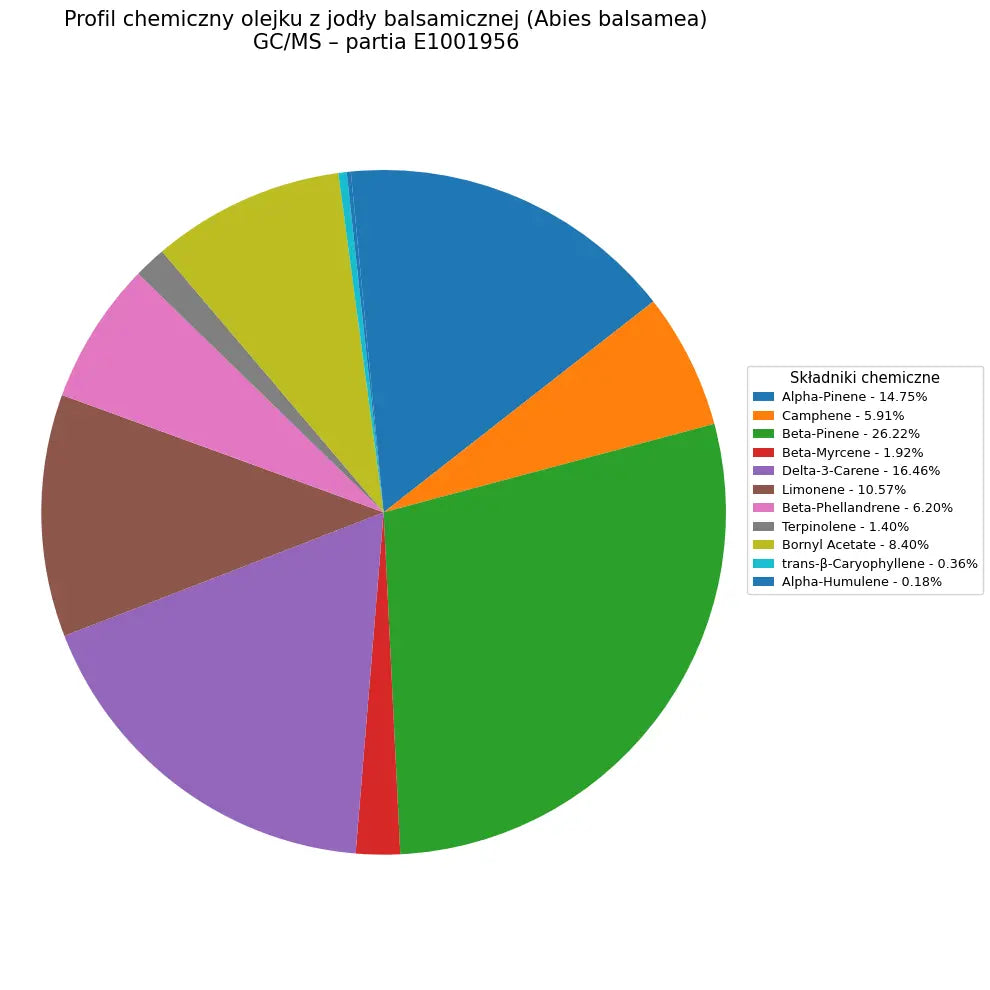
Batch E1001956 is distinguished by a balanced profile where no single component dominates. It contains β-pinene 26.22%, δ-3-carene 16.46%, α-pinene 14.75%, limonene 10.57%, and bornyl acetate 8.40%. The four main monoterpenes – β-pinene, δ-3-carene, α-pinene, and limonene – collectively account for exactly 68% of the indicated profile.
The prevalence of volatile monoterpenes is responsible for the freshness, intense spread of the aroma, and its distinctly forest-like character. Bornyl acetate softens the terpene sharpness, giving the composition a softer, more balsamic, and slightly sweet finish.
Balsam fir acts aromatically in two directions. On the one hand, it refreshes, stimulates, and helps organise thoughts; on the other hand, it brings a sense of stability, space, and connection with nature. It is not a heavy or strongly calming wood oil. Its character remains bright, green, and invigorating, but it is milder and more harmonious than the profile of many pine oils.
Product properties
- Country of origin: Canada
- Part of the plant: needles and twigs
- Cultivation: wild harvest
- Organic compound groups: monoterpenes, esters
- Botanical family: Pinaceae
- Botanical name: Abies balsamea
- INCI: Abies Balsamea Needle Oil
- Extraction method: steam distillation
Therapeutic properties
Nervous system and emotions
- supports clarity of thought and concentration
- refreshes during mental fatigue and energy drops
- can help regain motivation and readiness for action
- creates an atmosphere of spaciousness, freshness, and inner order
- helps recreate the natural atmosphere of a coniferous forest indoors
- promotes regaining stability without causing a heavy sedative effect
- effective during work, study, and monotonous tasks
- can support individuals feeling overwhelmed by enclosed, intensively used spaces
Body support
- supports a feeling of freer and deeper breathing
- traditionally used in compositions for the autumn-winter period
- effective in diffusion when air freshening is needed
- can be used in diluted massage blends after exertion
- refreshes tired muscles, back, and feet
- gives massage oils a forest-like, regenerating character
- supports a feeling of lightness and freshness after prolonged static positions
- can be an ingredient in aromatic balms for chest and back care
GC/MS Analysis
Chemical Structure – Key Components
- β-Pinene – 26.22% – monoterpene
- δ-3-Carene – 16.46% – monoterpene
- α-Pinene – 14.75% – monoterpene
- Limonene – 10.57% – monoterpene
- Bornyl acetate – 8.40% – monoterpene ester
- β-Phellandrene – 6.20% – monoterpene
- Camphene – 5.91% – monoterpene
- β-Myrcene – 1.92% – monoterpene
- Terpinolene – 1.40% – monoterpene
- trans-β-Caryophyllene – 0.36% – sesquiterpene
- α-Humulene – 0.18% – sesquiterpene
β-Pinene, α-pinene, and δ-3-carene – the main forest structure
β-Pinene, α-pinene, and δ-3-carene collectively constitute 57.43% of the indicated profile. These build the fresh, green, and resinous character of the essential oil.
β-Pinene gives the aroma a dry, green freshness reminiscent of broken needles and young twigs. α-Pinene enhances the sensation of clean, cool air and is responsible for the distinct, recognisable coniferous direction. δ-3-Carene brings slightly warmer notes of resin, sweet wood, and heated needles.
This combination creates a fresh and decisive profile, but more multi-dimensional than in oils almost entirely dominated by α-pinene.
Limonene and β-phellandrene – freshness and citrus brightness
Limonene 10.57% and β-phellandrene 6.20% brighten the composition, introducing light citrus, green, and spacious notes.
Limonene prevents the aroma from being heavy or overwhelmingly resinous. It adds luminosity and an energising character. β-Phellandrene enhances the sensation of fresh needles and cool air, while also imparting a subtle, citrus-green nuance to the scent.
Bornyl acetate – balsamic softness
Bornyl acetate constitutes 8.40% of the composition and is the most important element distinguishing balsam fir from sharper, strongly pinene-rich pine oils.
It brings a soft, slightly sweet, and balsamic tone that smooths out the volatile monoterpenes. Thanks to its presence, the oil retains its freshness but should not be perceived as overly sharp or turpentine-like.
The bornyl acetate content is not high enough for the oil to become heavy or deeply calming. However, it is sufficient to give it a more harmonious, rounded, and pleasantly balsamic finish.
Camphene, β-myrcene, and terpinolene
Camphene enhances the dry, cool, and slightly camphoraceous aspect of the aroma. β-Myrcene adds a small amount of green, earthy, and delicately balsamic tones, while terpinolene complements the profile with a subtle, fresh, and slightly sweet nuance.
These components do not dominate but increase the complexity of the aroma and prevent it from being one-dimensionally piney.
Scent profile
- Aroma: coniferous, green, resinous, balsamic, fresh, slightly citrusy and woody
- Color: colorless to pale yellow
- Consistency: clear liquid
- Scent note: top notes transitioning to heart notes
Application
Diffusion – the freshness of a Canadian forest
Add the essential oil to a diffuser according to the device's instructions. Use alone or combine with other coniferous, citrus, woody, and resinous oils.
Balsam fir will work well during work, study, a morning ritual, or when you need to refresh the atmosphere in a frequently used room.
Inhalation – clarity and breathing comfort
Apply the oil to a personal inhaler wick or use in a short, indirect inhalation. The fresh aroma of pine needles can be helpful for fatigue, reduced concentration, and the need to regain a sense of space and easier breathing.
Post-exertion massage
Combine with a carrier oil and use to massage tired muscles, back, or feet. For daily body use, a 1–2% dilution is usually appropriate.
Balsam fir can be combined with juniper, lavender, cedar, or frankincense, creating a forest-like composition that supports post-activity rest.
Forest refreshing ritual
Combine balsam fir with juniper berry, lemon, and cedar, then use in a diffuser. This blend helps create an atmosphere of a fresh, open forest and supports concentration and a sense of energy.
Calming composition
To give balsam fir a calmer character, combine it with lavender, frankincense, or Himalayan cedar. Oils with a slower and deeper profile will soften the freshness of the monoterpenes and extend the presence of the composition in the space.
Safety
Safety and warnings:
- Apply to skin only after dilution.
- For daily body use, a 1–2% dilution is usually appropriate.
- Do not apply directly to open wounds or damaged skin.
- Avoid contact with eyes, inside the nose, and mucous membranes.
- Perform a patch test on a small area of skin before first use.
- The essential oil is not phototoxic.
- Due to the high monoterpene content, the oil is prone to oxidation.
- Oxidized or improperly stored oil may increase the risk of irritation and allergic reactions.
- Individuals with respiratory hypersensitivity should start diffusion with a very small amount.
- Consult a specialist during pregnancy, breastfeeding, and when using with children.
- Do not use internally.
Storage and shelf life
Declared shelf life: 5 years from production date
Store in a tightly sealed bottle, in a cool and dark place, away from sunlight, humidity, and heat sources. Close the packaging thoroughly after each use to limit oxygen access.
Blends for Balsam Fir Essential Oil
Siberian Fir – increases balsamic softness and gives the composition a calmer, more enveloping character
Black Spruce – deepens the forest profile and introduces darker notes of resin, bark, and damp wood
Juniper Berry – enhances the feeling of purity, spaciousness, and cool forest air
Himalayan Cedar – creates a stable, woody base and extends the presence of fir in the composition
Frankincense – combines the freshness of pine needles with balsamic, meditative depth
Lavender – softens terpene intensity and creates a more harmonious blend for relaxation
Lemon – strengthens the bright, fresh, and energising direction of the oil
Cardamom – adds warmth, subtle sweetness, and spicy depth, creating an elegant composition for colder months
Why choose Balsam Fir Essential Oil?
The value of this batch is not determined by the extreme dominance of a single compound, but by a well-balanced combination of the most important components of coniferous essential oils.
β-Pinene 26.22%, δ-3-carene 16.46%, α-pinene 14.75%, and limonene 10.57% create a fresh, green, and resinous structure, while bornyl acetate 8.40% gives it a soft, balsamic finish.
As a result, the essential oil is distinctly coniferous but not one-dimensional. It combines the aroma of freshly broken twigs, cool air, and resin with a subtle citrus light and a milder, almost sweet base.
This is not the most intense or the most calming coniferous oil. Its uniqueness lies in the balance between refreshment and balsamic softness. It will be a good choice for those who are looking for the natural aroma of a North American forest, but do not want the sharp, turpentine-like profile typical of some pine oils.
How does balsam fir differ from other coniferous essential oils?
Essential oils of balsam fir, Siberian fir, black spruce, and black pine belong to the same botanical family, Pinaceae. All can be used in forest-like, refreshing compositions that support respiratory comfort and post-exertion recovery. However, they differ in the proportions of their main components, and thus in their character and intensity of aroma.
Balsam Fir Essential Oil (Abies balsamea) – a balance of freshness and balsamic softness. One of the best oils if you are looking for the authentic scent of a fresh Christmas tree.
The batch from Canada contains 26.22% β-pinene, 16.46% δ-3-carene, 14.75% α-pinene, 10.57% limonene, and 8.40% bornyl acetate.
No single compound dominates the entire profile. As a result, the aroma is multidimensional: fresh, green, resinous, slightly citrusy, and balsamic.
Balsam fir will be suitable for those seeking a natural coniferous forest aroma that is distinctly refreshing but remains milder and more harmonious than strongly pinene-rich pine oils.
Siberian Fir Essential Oil (Abies sibirica) – drier, softer, and more balsamic
In a typical Siberian fir profile, bornyl acetate plays a larger role, accompanied by camphene and monoterpenes. This gives the oil a drier, milder, and more balsamic aroma.
Siberian fir is usually calmer and more enveloping, while Canadian balsam fir is greener, more resinous, and more energising.
Black Spruce Essential Oil (Picea mariana) – deeper and more grounding
Black spruce usually has a darker, deeper, and more resinous aroma, reminiscent of bark, damp wood, and a dense northern forest.
In forest compositions, it creates a more stable and grounding base. Balsam fir is brighter, greener, and more spacious, with a more pronounced citrus brightness.
Black Pine Essential Oil (Pinus nigra) – most intense and α-pinene-focused
The batch of Greek black pine contains as much as 82.08% α-pinene. Such strong dominance of a single compound gives it a decisive, penetrating, and very resinous character.
Compared to it, balsam fir is more complex and softer. It contains significantly less α-pinene but more β-pinene, δ-3-carene, limonene, and bornyl acetate. As a result, it remains fresh but is less sharp and more balsamic.
Key difference
- Balsam fir – fresh, green, slightly citrusy, and balsamically soft
- Siberian fir – drier, calmer, and more enveloping
- Black spruce – deeper, darker, resinous, and grounding
- Black pine – most intense, penetrating, and dominated by α-pinene
Batch Information
- Production date: May 2025
- Expiration date: May 2030
- Country of origin: Canada
- Batch number: E1001956
Laboratory documentation MSDS + GC-MS analysis
Quality Guarantee – GC/MS and GC/FID Tests
Vessel essential oils are tested using GC/MS and GC/FID methods, confirming their authenticity, purity, and compliance with the natural profile of the plant.
Gas chromatography coupled with mass spectrometry (GC/MS) in SCAN mode is used in the analysis to precisely identify each component. The quantitative composition is determined by the GC/FID method. This ensures that we offer only natural essential oils, without synthetic additives – ideal for professional aromatherapy applications.
(INCI: Abies Balsamea Needle Oil)

How do I know this oil is better?
You are buying more than a scent. You are choosing purity, quality, and certainty about what enters your home. Choose an oil whose ingredients you truly know.
Discover our oils| AromaPremium Oils | Products without full transparency | |
|---|---|---|
| Confirmed purity | ||
| 100% natural ingredients | ||
| No artificial additives | ||
| Undiluted product | ||
| Known origin of plants | ||
| Product freshness | ||
| The quality of each batch | ||
| Full transparency | ||
| Greater purchasing confidence |

Your trust is very important to us
To ensure full quality transparency, we provide GC/MS reports for each oil.
GC/MS tests confirm the purity and authentic chemical composition of the oils , so you can be sure that you are using the highest quality products.
To view the GC/MS report for a given oil, simply click the PDF available on the product page. We publish GC/MS reports for individual oil batches one by one.
For each oil, we have also prepared a graphical summary of the composition in the form of a pie chart , which makes it easier to understand the chemical profile of the batch.
⚖️ Aromatherapy quality
Aromatherapy AI Assistant

Original products sourced from verified suppliers
Choose authentic essential oils – avoid unverified or unknown sources

Customer satisfaction is our priority